
A three year old in our clinic hadn’t tried a single piece of fruit in two years. Then he rolled a blueberry down Bluey’s slide, picked it up at the bottom, and ate it. Nobody asked him to.
Children are naturally curious, but a child can’t be curious and scared at the same time. And that includes being scared of food. Sometimes a favourite activity or toy can make them feel safe enough to get curious.
Here for the toys from the reel? Jump straight to them.
Why calm comes before curiosity
Being cautious about new food is a built-in safety instinct. It’s there to stop young children eating something that could make them sick. A 2025 review of 142 studies describes it as fear or disgust towards new food, and links it to higher anxiety in children.
When a child’s nervous system decides they’re not safe, it shifts towards fight or flight. Appetite drops and curiosity switches off.
Pressure makes it worse. “Just one bite” feels small to us. To a child already on alert, it’s one more reason to stay there. The same review found that pressuring or controlling feeding was linked to more picky eating, not less. And in a classic experiment, preschoolers pushed to finish their soup ate less of it and said more negative things about it.
Play is low stakes, and the child is in charge. In a 2022 study of 110 three- and four-year-olds, the children who got to look at, smell and touch vegetables before they were offered were the most willing to taste them, and ate the most. The more senses involved, the better they did.
How to tell if your child is ready for food play
Before any food comes out, check how your child is going. If they’re not regulated, adding food will only make it harder.
Ready usually looks like:
- A body that’s loose and settled, not bouncing off the walls or flat on the couch
- Playing, chatting or following your lead
- Shrugging off small frustrations fairly quickly
- Interested in what’s going on around them
Not today usually looks like:
- Hungry, tired, unwell or just home from a big day at kindy
- Wired, clingy, teary or quick to anger
- Already said no to everything this morning
- Zoned out or hard to reach
If it’s a not-today day, leave the food in the fridge. Help them settle first, with whatever works for your child. That might be a run in the backyard, a cuddle or a quiet spot. Then bring out the toy on its own. The food can come tomorrow.
Keep watching once you’ve started. If your child starts to look away, wind up or shut down, move the food further away and go back to just the toy.
Where and when to do food play
Not at dinner, and not at the dinner table. A different time and place stops your child linking food play with meals, and removes the expectation to eat.
- A dry shower floor. Make as much mess as you like, then turn the tap on.
- The bath. Warm water calms lots of kids, and the trucks wash clean as they go.
- Outside. Grass, the sandpit or a tray on the deck. The hose does the cleanup.
Four things that help food play work.
- Use food you don’t need them to eat. If you’re counting on the broccoli for dinner, it isn’t play.
- Play too. Your hands in the mud show them it’s safe.
- Have a way out. A bowl of water or a cloth means they can wipe off any time.
- Stop while it’s still fun. Five good minutes beats twenty that end in tears.
The toys we use in feeding therapy
Start with whatever your child is obsessed with, whether that’s dinosaurs, Peppa Pig, diggers or the infamous Heeler dogs from Brisbane. A favourite character turns “eat this” into “help Bingo push it down the slide”, and your child engages with the game, relaxed.
You don’t need any of these toys. Whatever your child already plays with will do the job. These are just the ones in our therapy cupboard. Nothing here is sponsored, and most of it costs less than $20 at Kmart.
Bluey Deluxe Playground
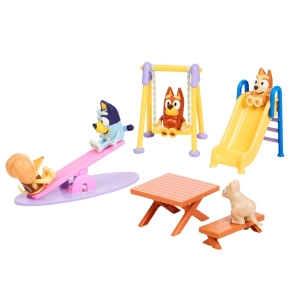
It’s our favourite. It comes with a slide, a swing, a seesaw, a picnic table and four very patient dogs!
Try it: Race foods down the slide. Older kids love the seesaw, so ask which is heavier, a strawberry or a cube of cheese, and let them test it. Or drop Bluey into a container of jelly and send in a rescue team with a spoon. We did that one recently with a child who’d never had jelly and didn’t like the look of the wobble. By the end of the rescue they were touching it, and then they tried some.
What it’s doing: It turns food into a science experiment. Does a blueberry roll faster than a pea? Will a sultana stay on the swing? Kids are looking closely at a food’s shape, weight and texture, and none of it involves eating.
Bluey Deluxe Playground Playset, Kmart
Construction trucks

Your toddler doesn’t need to eat the broccoli today. They need to drive a dump truck through it.
Try it: Load the dump truck with peas. Scoop yoghurt with the excavator. Bulldoze a road through mashed potato and check out the tracks. Then take the whole fleet to the bath for a truck wash.
What it’s doing: A tool lets your child move food before they’re ready to touch it. Pushing a truck through thick mash is also heavy work for the hands and arms, which calms a lot of kids. (OTs call this proprioceptive input. It’s the same reason a firm bear hug settles some children.)
5 Pack Construction Vehicles Set, Kmart
Peppa Pig figurines

Peppa is very brave. George has opinions.
Try it: Let your child run the show. What would Peppa like to eat? If Peppa has a turn, now it’s our turn! If George decides he doesn’t like it, that’s fine. “George doesn’t like it today” is a useful sentence for a toddler to practise.
What it’s doing: Pretend play puts a bit of distance between your child and the food. Peppa can sniff the capsicum first. George can lick it. Daddy Pig can eat the lot. Your child watches someone they trust go first, and the pressure sits on Peppa instead of them.
Peppa Pig: Peppa’s Family of Five, Kmart
Farm animals and tweezers

Oh no! The pigs have fallen in the mud again. Somebody has to get them out.
Try it: Make mud from chocolate pudding, cocoa stirred through Greek yoghurt, or corn flour. Sink the pigs, cows and sheep. Hand over the tweezers and announce an emergency. Rescued animals will need a bath.
What it’s doing: Tweezers let a child explore a wet, sticky texture without touching it. Squeezing them builds the hand strength and finger control they’ll later use for a fork. And a rescue mission gives them a reason to go in that has nothing to do with food.
60 Piece Farm Animals Adventure Set, Kmart · Kadink Tweezers 6 Pack, Kmart
Dinosaur sensory bin
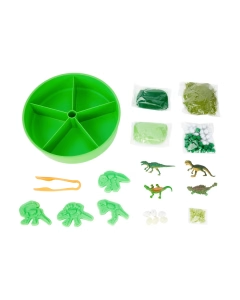
Try it: Keep the dinosaurs, eggs and tongs, and swap the clay for food. Start with dry pasta or cereal. Then try cooked pasta, then a jelly swamp. Bury the eggs and go digging.
What it’s doing: Digging and burying are great heavy work. A sensory bin also lets you change a texture slowly. Start dry and crunchy, and move towards soft and damp as your child gets comfortable.
20 Piece Sensory Bin: Dinosaur, Kmart
Play-Doh pizza oven

Try it: Run a pizza shop with the dough first. When they’re ready, make real mini pizzas on wraps or pita bread, and let them choose and place every topping. Touching and arranging counts, even if nothing gets eaten.
What it’s doing: Lots of kids who avoid sticky or wet food are fine with Play-Doh. It’s predictable and barely leaves anything on your hands. Rolling, pressing and stamping work the small muscles of the hands, and making a pretend pizza is a dress rehearsal for the real thing.
Play-Doh contains wheat, so skip this one if your child has coeliac disease or a wheat allergy.
Play-Doh Stamp and Spin Pizza Playset, Kmart
Wooden fruit cutting set and shape cutters

A star is less suspicious than a slice.
Try it: Play fruit shop with the wooden set, then do the same job with a real banana and a butter knife. Use the cutters to press stars, hearts and flowers from cucumber, watermelon, cheese and bread, and let your child do the pressing. Decorate a plate for Peppa, or lay a road for the trucks.
What it’s doing: Cutting uses two hands doing two different jobs, one holding and one cutting. OTs call this bilateral coordination. Wooden fruit lets your child practise with no smell or juice. Shape cutters change how a real food looks without changing what it is.
8 Piece Wooden Fruit Cutting Set, Kmart · Appetito 12 Piece Fruit and Vegetable Cutters, Kmart (online only)
Arts and crafts with food
You don’t need a single toy for these. A plate, a tray or a sheet of baking paper will do.
Painting with sauces and dips
Try it: Paint with tomato sauce, yoghurt, hummus or guacamole on a plate or baking paper. Start with a brush and move to fingers when they’re ready. A breadstick makes a good brush, and it comes pre-dipped.
What it’s doing: Sauces and dips are a big step for lots of kids. They’re wet, they spread, and they end up everywhere. A paintbrush lets your child explore one at arm’s length first. Finger painting comes later, once the brush feels easy.
Making pictures with food
Try it: Build a stick figure from pretzel sticks with a cracker for a head. Make a flower with cucumber petals and a cherry tomato in the middle, or a dog with a slice of bread for a body and sultanas for eyes. It doesn’t have to look like anything. A dog with five legs is still a dog.
What it’s doing: Making a picture means picking up, moving and placing every piece. That’s a lot of touching, and all of it goes into making something, not eating it. It also gets your child looking closely at colours and shapes.
Rice cake faces
Try it: Spread a thin layer of cream cheese or hummus as glue. Add eyes, a nose, a mouth and some hair. Grated cheese and grated carrot both make good hair. Then ask your child what kind of mood the face is in.
What it’s doing: A rice cake or corn cake is plain, crunchy and predictable, so most kids are happy to hold one. Giving it a face puts new foods right next to a safe one.
A quick safety note
Most of these toys are labelled 3+ and have small parts. With two-year-olds, stay right there, put the tiniest pieces away and stick to the bigger ones.
Food play often ends with something in a mouth, which is great. Prepare food as if they’ll eat it. Quarter round foods like blueberries, grapes and cherry tomatoes, and skip hard raw chunks and whole nuts. The Royal Children’s Hospital has a clear guide to choking prevention. And never leave a toddler alone in the bath.
When play isn’t enough
Play won’t be enough for every child.
It’s worth getting support if your child:
- Gags or vomits at the sight or smell of food
- Eats a list of foods that keeps getting shorter
- Ends most mealtimes in tears, or you do
- Has you worried about their growth or energy
- Coughs, chokes or sounds gurgly or wet while eating or drinking
That’s what a feeding therapist is for. We’ll work out what your child needs to feel safe around food, and build a plan that fits your actual child and real life.
Nobody asked that three-year-old to eat the blueberry. If you’d like help working out what your child needs to get there, Book a Chat. It’s free, it’s 15 minutes, and you don’t need to have it all figured out first.